
Türkiye resumed passage through the Black Sea Straits, and many ships passed through the Straits smoothly
Temporary restrictions on the Turkish Straits have been lifted, and Black Sea shipping has gradually resumed normality.
On August 9th local time, Turkey officially lifted the temporary navigation restrictions on the Black Sea Straits and fully restored the passage rights of all types of ships to the Black Sea. The previous issues of vessel detention and passage delays caused by security control had been completely alleviated. With the implementation of policy adjustments, many stranded vessels successfully completed the passage through the Straits, and the Black Sea shipping chain returned to stability. Ship tracking data showed that the oil tanker "Aegean Dream" successfully entered the Dardanelles Strait on Sunday. The vessel had been waiting in the surrounding waters of the Strait since Thursday and had been stranded for nearly a week. The final destination of the vessel was the Caspian Pipeline Alliance Terminal in Novorossiysk, Russia. At the same time, the container ship "Mehmet Kahveci A" also successfully passed through the waterway on Sunday morning, heading towards the Novorossiysk port, marking the official end of this temporary control.
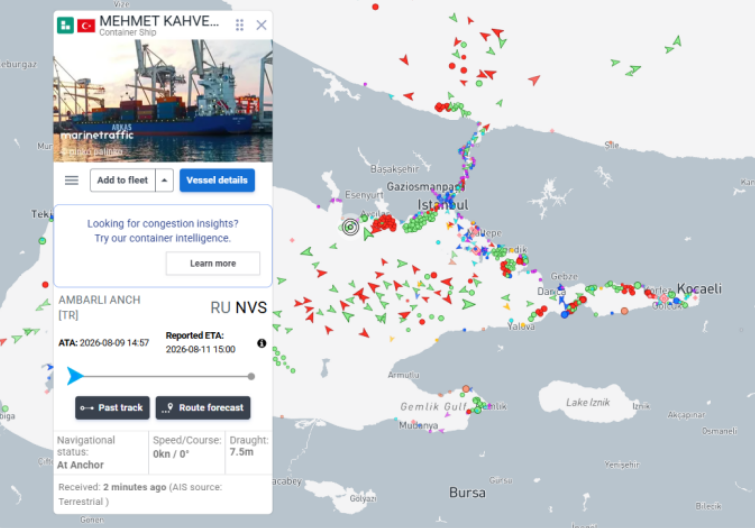
This round of Straits navigation restrictions began recently. Bloomberg previously disclosed that the Turkish Coast Guard temporarily informed all ships planning to sail to Russian and Ukrainian ports that they would suspend the issuance of navigation permits for corresponding routes, directly causing a large number of merchant ships to be stranded in the surrounding waters of the Straits. It is worth noting that during the implementation of the control measures, the Turkish authorities did not disclose the specific reasons for the control to the shipowners or release any official explanations. The Turkish Ministry of Transport and Infrastructure remained silent during media inquiries and did not make any public comments, which once caused concerns in the shipping market about the situation of Black Sea navigation and significantly increased regional shipping uncertainty.
The security risk in the Black Sea has risen, triggering Turkey's temporary navigation control measures.
The core reason for Turkey's temporary tightening of Straits navigation rights is the continuous deterioration of the shipping security situation in the Black Sea, with frequent attacks on merchant ships, directly threatening the national shipping interests. In recent days, the number of attacks on civilian merchant ships in the Black Sea has continued to increase, and many Turkish-owned and Turkish-flagged merchant ships have become the main targets of attacks. The regional navigation risk has sharply risen. Facing the escalating security risks, Turkey's concerns about the safety of Black Sea navigation have continued to intensify, and its external statements have become increasingly tough. Eventually, Turkey chose to implement temporary navigation control measures to avoid damage to its ships and shipping interests.
Two unnamed Turkish government officials confirmed the core logic of this control to Reuters. Turkey has been closely monitoring the security situation in the Black Sea region for a long time. In response to the frequent attacks on merchant ships in recent times, it has implemented temporary navigation control measures to ensure the safety of passing ships and crew. At the same time, Turkey clearly emphasized that all temporary control measures in this round strictly follow the relevant provisions of the 1936 "Montreux Convention", and are implemented within the jurisdictional framework granted by the convention. There is no illegal control or restriction of normal shipping. The control and subsequent lifting are based on legal grounds. This round of temporary control is an emergency regulatory measure under the circumstances of an escalated regional security risk, not a long-term navigation restriction. The purpose is to avoid shipping risks, rather than interfering with normal international trade shipping.
Turkey actively engaged in diplomatic mediation and called for a ceasefire in the Black Sea region and stable navigation.
While implementing temporary navigation control measures to ensure short-term shipping safety, Turkey actively engaged in diplomatic mediation and actively promoted the restoration of shipping order in the Black Sea region. Turkish Foreign Minister Hanak Fidan, in an interview with the official Anadolu Agency, publicly stated that Turkey has officially proposed to Russia and Ukraine to declare a "ceasefire order" for the Black Sea region and stop attacks on civilian merchant ships, in order to create a safe and stable navigation environment for international shipping. In addition, Turkey has refined and completed the maritime safety guarantee plan for the Black Sea, and has officially submitted it to the president for review. Currently, the relevant security measures are being gradually implemented, aiming to establish a long-term maritime safety control mechanism for the Black Sea, reducing the risk of attacks on merchant ships at their source and stabilizing the regional shipping order. According to Bloomberg, citing US officials, Ukraine has responded positively and agreed to provide security passage guarantees for some non-Russian oil tankers, providing an important support for the resumption of the通畅 of the Black Sea oil transportation route and also achieving phased results in Turkey's diplomatic mediation, effectively alleviating the regional shipping tensions.
Relying on the Montreux Convention to exercise authority and maintain a neutral and balanced shipping pattern
The core legal basis for Turkey's current control and lifting operations is the 1936 Montreux Convention, which is the core regulation for the navigation management of the Black Sea Strait. This convention clearly grants Turkey absolute jurisdiction over the Bosporus Strait and the Dardanelles Strait. The convention clearly stipulates the navigation rules, stating that during peacetime, civilian ships of all countries have the right to freely pass through the strait, while imposing strict restrictions on the passage of non-Black Sea coastal countries' warships. This not only guarantees the basic rights of international shipping but also establishes Turkey's core control position in the Black Sea strait.
Since the full outbreak of the Russia-Ukraine conflict in 2022, Turkey has always maintained an independent and autonomous diplomatic stance, maintaining strategic balance. It neither followed the Western camp in imposing sanctions on Russia, continuously maintaining economic and shipping cooperation with Russia, nor continuously providing military support to Ukraine, maintaining bilateral relations. This neutral and balanced diplomatic strategy has made Turkey a rare two-way communication bridge in the Russia-Ukraine conflict and enabled it to have the ability to independently mediate the situation of the Black Sea shipping. Relying on the jurisdiction over the strait and the diplomatic neutrality advantage, Turkey has continuously coordinated between the conflicting parties to minimize the impact of the geopolitical conflict on the international shipping and trade in the Black Sea.
The warming of the situation is beneficial to shipping. The Black Sea trade supply chain returns to stability
This round of the reopening of the strait means that the short-term risks of congestion, detention, and suspension of navigation in the Black Sea have been completely eliminated. It is a major positive for global energy transportation and the trade supply chain in the Black Sea region.