
European small package tariff reversal: France urgently suspends, Italy delays again!
July 1, 2026, is destined to be a milestone day in the history of cross-border e-commerce in Europe. On this day, the European Union officially cancelled the 35 year old policy of exempting packages under 150 euros from tariffs. However, on the same day, France and Italy staged an unexpected "policy reversal" - France announced the suspension of local small parcel taxes, while Italy once again postponed local administrative fees.
What exactly happened behind this series of changes? What does it mean for cross-border sellers?
1、 France: € 2 tax only lasts for four months, package volume drops by 90%
On March 1, 2026, France took the lead in charging a national tax of 2 euros per package of less than 150 euros from non EU countries, targeting Asian e-commerce platforms such as Shein, Temu, and AliExpress.
However, this highly anticipated tax policy was suspended after only four months of existence.
Why did it fail? The answer is simple: the "detour" ability of e-commerce platforms is too strong.
Due to the free flow of goods within the European Union, taxed platforms quickly found a solution - first air freight the goods to untaxed neighboring countries such as Belgium, the Netherlands, and Luxembourg, and then transfer them by land into France. The cost of transferring from Belgium to France is less than 0.1 euros per piece, much lower than the tax of 2 euros.
The results are shocking:
The Director General of the French Customs Administration revealed in mid May that since March 1st, the volume of declared packages in France has plummeted by about 90%, from 500000 per day to 50000.
The monthly revenue from this tax is only 2.3 million euros, far below the estimated 400 million euros for the entire year in the 2026 fiscal budget.
The large-scale transfer of logistics flow to neighboring countries has caused French logistics companies to lose a large number of cargo flights, and it is expected that 500 to 1000 jobs will be lost by this summer.
French Trade Minister Papin frankly stated that this is a "strategic pause" aimed at facilitating the smooth implementation of the EU's unified tariffs. The French Ministry of Finance stated in a statement, "We love our Belgian friends very much, but if small packages continue to flow into France and only they can receive this tax, it is clearly abnormal
The Office of the French Minister of Public Accounts also stated that "France has indeed played a pioneering role" - it was France's pioneering action that pushed the EU to advance the implementation of unified tariffs from the initially mentioned 2028 to 2026.
2、 Italy: Three extensions, from January to October
The situation in Italy is similar to that in France, but the response is more "flexible".
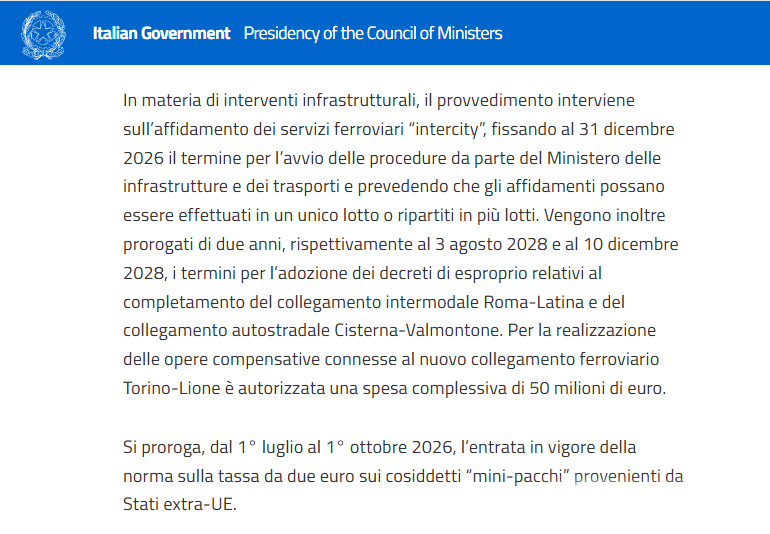
The Italian government introduced a 2 euro administrative fee for non EU imported small bags under 150 euros in the 2026 fiscal budget bill, originally scheduled to be officially implemented on January 1, 2026. However, this policy has experienced three delays:
First time: Due to insufficient preparation by the customs system, the deadline has been postponed from January 1st to July 1st.
Second time: In March 2026, Italy announced a suspension until June 30th, citing the need to allow time for adjustments to the customs information system.
The third time: On June 22, 2026, the Italian Cabinet passed a decree to postpone the implementation time again to October 1.
Why does Italy keep pushing? The core reasons are also "double taxation" and "loss of goods flow".
After the EU's unified tariff of 3 euros comes into effect on July 1st, if Italy's 2 euros domestic fee is implemented simultaneously, it will form a double taxation of "3+2=5 euros". The logistics industry association strongly warns that double charges will result in over 50% of low value cross-border packages bypassing local customs clearance in Italy.
tariff
In fact, before this delay, 50% of Italy's cross-border cargo flow had already been lost in the first two months of this year. The Italian National Federation of Transport and Logistics Enterprises has stated that this 2 euro fee will directly lead to a decrease of at least 50% in cross-border freight volume, resulting in a loss of 25 million euros in national tax revenue.
Interestingly, on July 1st, Italian media ItaliOggi even published an article stating that "Italy's small parcel tax may never truly come into effect" - because the EU unified management fee will be fully implemented before November, at which time the unilateral surtax of each country will completely lose its meaning.
3、 EU unification policy: 3 euro tariffs officially introduced
At the same time as the suspension in France and the extension in Italy, the new unified policy at the EU level officially came into effect on July 1st.
The key points of the new policy are as follows:
Cancel tax exemption threshold: Abolish the policy of exempting tariffs on packages below 150 euros that has been implemented for 35 years.
Transition period arrangement: From July 1, 2026 to July 1, 2028, for small packages with a value less than 150 euros, a temporary fixed tariff of 3 euros will be levied on each category of goods according to the customs tariff subheading to which the goods in the package belong.
Multi category overlay billing: If a package contains three different categories of goods, it will be charged 9 euros; If only multiple similar items are included (such as three dresses), only 3 euros need to be paid.
Normalization after the transition period: Starting from July 2028, after the full launch of the EU Customs Data Center, taxation will be based on the standard commodity tax rate.
In addition, starting from November 2026, the EU will also charge an additional "European parcel handling fee", expected to be 2 euros per package. At that time, the comprehensive cost of a single cross-border direct mail package will increase by 5 to 8 euros.
According to data from the European Commission, the background for the introduction of this tariff is the skyrocketing scale of cross-border e-commerce express shipments: the total number of small packages flowing into the EU in 2024 reached 4.6 billion, of which 91% came from China. In 2025, Europe delivered approximately 5.8 billion small packages, of which 97% came from China.
4、 The impact and suggestions on cross-border sellers
Short term: 3-month buffer period
For sellers primarily engaged in the Italian market, July to September 2026 is a brief window of opportunity - packages under 150 euros shipped directly to Italy will only be subject to a unified EU tariff of 3 euros, without the need to pay an additional 2 euros in local fees. Sellers with an average of 100 orders per day can save thousands of RMB in costs per month.
Long term: Cost increase is inevitable
Don't mistakenly think that the policy will be cancelled. The extension by Italy is just a "delaying tactic", and from October 1st, the 2 euro fee will be officially added to the EU tariffs. France's suspension is only a 'strategic concession', giving way to the EU's unified tax system.
The general direction of EU unified taxation is irreversible.
Three major response suggestions
1. Calculate costs in advance and adjust pricing strategies
During the transition period, the rule of 3 euros per category of goods and multiple category stacking charges means that the taxes and fees for mixed packages may far exceed expectations. Sellers need to recalculate logistics costs and adjust product pricing in a timely manner.
2. Optimize logistics layout and consider overseas warehouse mode
The dividends of the low-priced direct mail model have been exhausted. The top platform has taken the lead in action - Shein has shifted 60% of European orders to local warehouses, and Temu plans to achieve a European warehouse coverage rate of 80% by the end of 2026. Overseas warehouses can not only avoid direct mail tariffs, but also improve performance time and consumer experience.
3. Pay attention to the follow-up policies of the European Union and lay out compliance plans in advance
Starting from November 2026, the European Union will officially implement a unified package handling fee. After July 2028, the existing temporary tariff of 3 euros will be replaced by a new tariff system levied by commodity category. In addition, in the future, online platform sellers will act as "responsible importers" and assume major responsibilities such as customs compliance, safety, and environmental protection. Policies will only become increasingly strict, and early compliance is the correct solution.
In conclusion
The seemingly contradictory policy reversals of the "four month premature death" of France's small parcel tax and the "three time extension" of Italy's fees precisely reveal a core logic: under the rules of free circulation within the European Union, unilateral taxation by any country is doomed to fail.
The big ship of the EU's unified tax system has set sail. For cross-border sellers, this is not a 'crisis', but a signal of industry reshuffle. The model of relying on low-priced direct mail and low profit high sales will eventually be eliminated. Only by complying with regulations in advance, optimizing logistics layout, and enhancing product value can we establish a firm foothold in the European market.
The three-month buffer period is fleeting. Are you ready?